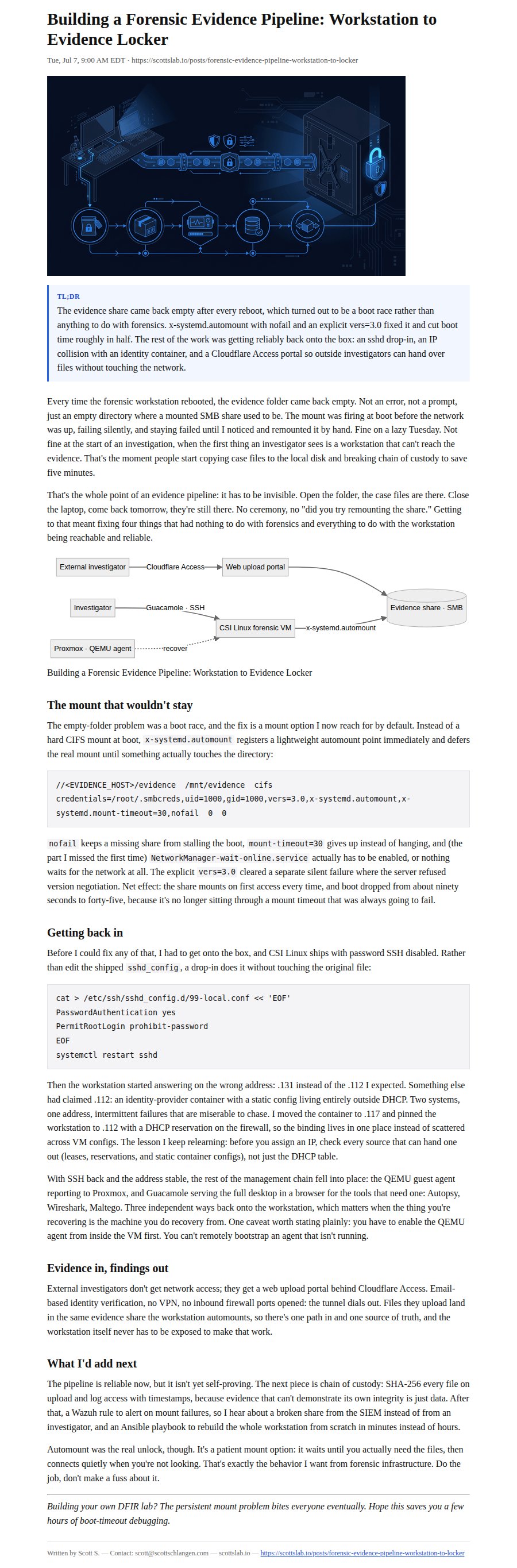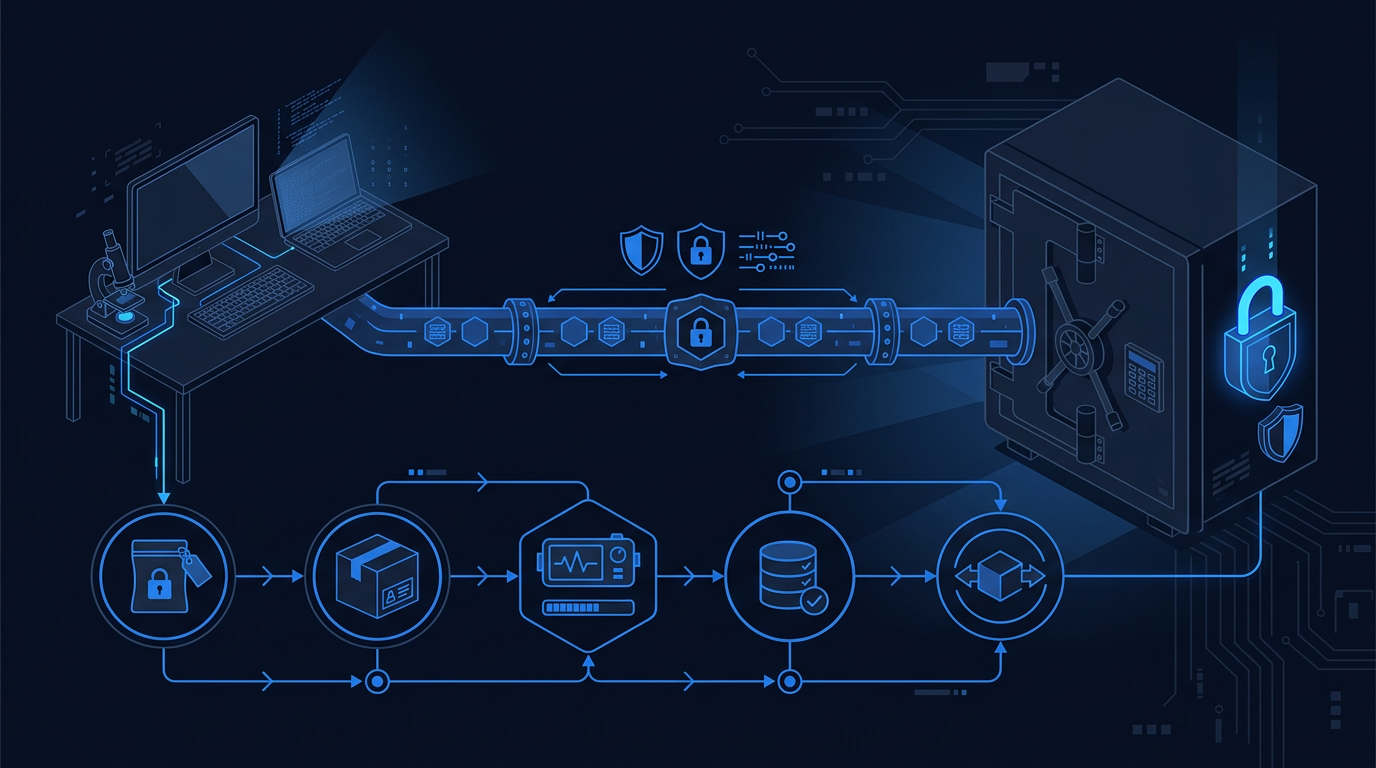
Building a Forensic Evidence Pipeline: Workstation to Evidence Locker

Published: February 2026 Category: Digital Forensics Reading Time: 12 minutes


Executive Summary

  • Fixed persistent SMB evidence share mount on forensic workstation using systemd automount - zero manual intervention after boot
  • Resolved IP address conflict where an identity provider container had stolen the forensic workstation's IP
  • Restored SSH access via drop-in config (password auth was disabled by default)
  • Established web upload portal behind Cloudflare Access for external investigators with email-based authentication
  • Achieved full remote management chain: SSH + QEMU guest agent + Guacamole web desktop

Goal

Problem: My forensic workstation couldn't reliably access the centralized evidence repository after reboots. Every time the VM restarted, I had to manually mount the evidence share before investigators could access case files. This was a race condition - the mount attempted before the network was fully up, failed silently, and stayed failed.

Why it mattered: During an active investigation, the last thing you want is infrastructure troubleshooting. Investigators need to open their workstation, navigate to the evidence folder, and start working. If the mount is broken, they're either stuck waiting for IT support or - worse - they start copying evidence locally and break chain of custody. A forensic evidence pipeline must be invisible and reliable.


Scope and Constraints

In Scope

  • Persistent SMB mount from forensic workstation to evidence share
  • SSH access restoration for remote administration
  • IP address conflict resolution
  • QEMU guest agent connectivity for Proxmox management
  • Web upload portal authentication for external investigators

Out of Scope

  • Evidence share server configuration (already operational)
  • Forensic tool installation on the workstation
  • Case management software integration
  • Chain-of-custody logging (future improvement)

Key Constraints

  • No boot delays - Failed mounts cannot stall the boot process
  • Zero manual intervention - Evidence must be accessible without investigator troubleshooting
  • Preserve existing access - External investigators already using the web portal cannot be disrupted
  • Forensic integrity - No changes that could compromise evidence handling

Tools and References

Tool Role in This Project
CSI Linux Forensic workstation distribution - purpose-built for DFIR investigations
Samba/CIFS Network file sharing protocol for evidence share access
systemd automount Lazy mounting - defers mount until first directory access
Cloudflare Access + Tunnels Zero-trust authentication for web upload portal
pfSense DHCP reservations, IP address management
Proxmox VM hypervisor hosting the forensic workstation
QEMU guest agent In-VM agent for remote management (shutdown, IP reporting, etc.)

References:


Approach

Phase 1: Diagnose the Mount Failure

What I did: SSH'd into the forensic workstation (after fixing SSH access - see Phase 3) and checked mount status, systemd service logs, and fstab configuration.

Why: The symptom was "evidence folder empty after reboot" but the root cause could be anywhere: network timing, authentication, share availability, or fstab syntax.

Phase 2: Fix the Fstab Entry

What I did: Added systemd automount options to the fstab entry: x-systemd.automount, nofail, and x-systemd.mount-timeout=30. Enabled NetworkManager-wait-online.service.

Why: The original fstab entry attempted a hard mount at boot time. If the network wasn't ready (common in VMs), the mount failed. Automount creates a lightweight kernel mount point immediately, then triggers the real CIFS mount only when something actually accesses the directory.

Phase 3: Restore SSH Access

What I did: Created a drop-in config file at /etc/ssh/sshd_config.d/ to enable password authentication and permit root login for initial setup.

Why: CSI Linux ships with password auth disabled for security. That's fine for a workstation, but I needed remote access to troubleshoot. Drop-in configs are cleaner than editing the main sshd_config.

Phase 4: Resolve IP Conflict

What I did: Discovered the forensic workstation was getting .131 instead of its expected .112. Traced the conflict to an identity provider container that had a static IP config claiming .112. Moved the container to .117, created a DHCP reservation for the forensic workstation at .112.

Why: Two systems claiming the same IP causes intermittent connectivity failures that are maddening to debug. DHCP reservations (MAC-to-IP binding) on the firewall are more maintainable than static configs scattered across VMs.

Phase 5: Verify Remote Management Chain

What I did: Confirmed QEMU guest agent was running, tested Proxmox VM controls (shutdown, reboot), verified Guacamole web desktop access through the existing tunnel.

Why: The full management chain (SSH + QEMU agent + web desktop) means I can recover from almost any failure state without physical console access.


Implementation Notes

Fstab Entry with Automount (Sanitized)

# /etc/fstab - Evidence share mount
//<EVIDENCE_HOST>/evidence  /mnt/evidence  cifs  credentials=/root/.smbcreds,uid=1000,gid=1000,vers=3.0,x-systemd.automount,x-systemd.mount-timeout=30,nofail  0  0

Key options explained:

  • x-systemd.automount - Creates automount point, real mount on first access
  • x-systemd.mount-timeout=30 - Give up after 30 seconds instead of hanging
  • nofail - Don't fail boot if mount fails
  • vers=3.0 - Explicit SMB version (some servers require this)

SSH Drop-in Config (Sanitized)

# Create drop-in directory if needed
mkdir -p /etc/ssh/sshd_config.d/

# Create override config
cat > /etc/ssh/sshd_config.d/99-local.conf << 'EOF'
# Local overrides for forensic workstation
PasswordAuthentication yes
PermitRootLogin prohibit-password
EOF

# Restart SSH
systemctl restart sshd

Assumption: The base sshd_config includes Include /etc/ssh/sshd_config.d/*.conf (standard on modern distros).

DHCP Reservation Pattern (Sanitized)

# pfSense DHCP reservation (conceptual)
Hostname: <FORENSIC_WS>
MAC Address: <WS_MAC_ADDRESS>
IP Address: <WS_IP_ADDRESS>
Description: Forensic workstation - CSI Linux

# Verify no IP conflicts before assigning:
# 1. Check DHCP leases
# 2. Check static mappings
# 3. Check container configs (they may have static IPs outside DHCP)
# 4. Ping the IP to see if anything responds

Enable Network Wait Service

# Enable the service that waits for network before continuing boot
systemctl enable NetworkManager-wait-online.service

# Verify it's enabled
systemctl is-enabled NetworkManager-wait-online.service

Validation and Evidence

Signals That Proved It Worked

Check Before After
Evidence share after reboot Empty folder (mount failed) Contents visible on first access
Boot time ~90s (mount timeout stalls) ~45s (automount is instant)
SSH access Connection refused Password auth working
IP address .131 (wrong) .112 (correct, DHCP reserved)
QEMU guest agent Not responding Reporting IP, accepting commands

Validation Commands (Sanitized)

# Check mount status
mount | grep evidence
# Expected: Shows CIFS mount to evidence share

# Check automount unit
systemctl status mnt-evidence.automount
# Expected: active (running)

# Verify network wait service
systemctl status NetworkManager-wait-online.service
# Expected: enabled, ran successfully at boot

# Test evidence access
ls /mnt/evidence/
# Expected: Case folders visible (triggers mount if not already mounted)

# Verify IP address
ip addr show | grep <EXPECTED_IP>
# Expected: Correct IP on primary interface

Results

Metric Outcome
Mount Reliability 100% - automount triggers correctly on every access
Boot Time Impact Reduced from ~90s to ~45s (no mount timeout stalls)
Manual Intervention Zero - investigators just open the folder
IP Stability DHCP reservation prevents future conflicts
Remote Management Full chain operational (SSH + QEMU + Guacamole)
External Access Web portal functional with Cloudflare Access auth

What I Learned

  1. x-systemd.automount is the correct pattern for network mounts. It creates a kernel automount point that triggers the real mount on first access. No boot timing issues, no race conditions, no stalled boots.

  2. NetworkManager-wait-online.service exists for a reason. Disabling it breaks any boot-time network dependency. If something needs the network at boot (mounts, NTP, DNS), this service must be enabled.

  3. Always check the IP map before assigning addresses. Multiple systems can claim the same IP through different mechanisms: DHCP reservation, static container config, DHCP lease, or manual assignment. Check all of them.

  4. QEMU guest agent is a prerequisite for remote VM management. Without it, you need console/VNC access to bootstrap anything. Can't remotely enable an agent that isn't running.

  5. SSH drop-in configs are cleaner than editing sshd_config. Files in /etc/ssh/sshd_config.d/ override the main config without touching it. Easier to track changes, easier to revert.

  6. SMB protocol version negotiation can fail silently. Some servers require explicit vers=3.0 in mount options. If mounts fail for no apparent reason, try forcing a specific version.

  7. DHCP reservations beat static IPs in VMs. Centralized management on the firewall, no config drift inside VMs, easy to see all assignments in one place.

  8. For forensic workstations, invisible infrastructure is critical. Investigators shouldn't troubleshoot mounts during an active case. Evidence access must be automatic and reliable.

  9. Cloudflare Access + Tunnels is excellent for zero-trust service exposure. External investigators can access the upload portal with email auth, no VPN required, no firewall ports opened.

  10. FreeBSD tools have different syntax than GNU. Commands that work on Linux (like sed -i) fail on pfSense. Always test before scripting.


What I Would Improve Next

P0 (Do This Week)

  • Mount failure alerting - Add Wazuh custom rule to alert if evidence share mount fails (watch for mount errors in syslog)

P1 (Do This Month)

  • Forensic workstation Ansible playbook - Automate the entire workstation setup so rebuilding the VM takes minutes, not hours
  • Read-only evidence mount - Create separate SMB share with read-only permissions for review-only investigators
  • QEMU guest agent auto-start - Configure via Proxmox VM settings so it survives reboots without manual intervention

P2 (Do This Quarter)

  • Chain-of-custody logging - Log all evidence file access with timestamps and user IDs to a separate audit log
  • Evidence checksumming - Auto-hash files on upload for integrity verification
  • Case folder templates - Auto-generate standard forensic directory structure when creating new cases
  • Tailscale backup access - Add mesh VPN path to evidence share for remote investigators if Cloudflare is unavailable

Common Failure Modes

  1. "Evidence folder is empty after reboot" - Check if automount unit is active (systemctl status mnt-evidence.automount). If not, verify fstab has x-systemd.automount. Try accessing the folder to trigger mount.

  2. "Mount times out during boot" - NetworkManager-wait-online.service may be disabled. Enable it and ensure nofail is in fstab so timeout doesn't stall boot.

  3. "SSH connection refused" - Check if sshd is running and whether password auth is enabled. Look for drop-in configs that may override settings.

  4. "Wrong IP address after reboot" - Another device may have the IP statically configured. Check DHCP leases, static mappings, and container configs. Create DHCP reservation with MAC binding.

  5. "QEMU guest agent not responding" - Agent may not be installed or running inside the VM. Requires console/VNC access to fix - can't bootstrap remotely without it.


Security Considerations

Evidence Integrity

  • SMB share uses authenticated access (credentials file with restricted permissions)
  • Cloudflare Access provides identity verification for external investigators
  • Future: chain-of-custody logging and checksumming will provide tamper evidence

Access Control

  • SSH password auth enabled only for initial setup - consider switching to key-only after configuration
  • DHCP reservations prevent IP spoofing within the trusted network
  • Web upload portal requires email-based authentication through Cloudflare Access

Network Segmentation

  • Evidence share is on internal network, not directly exposed to internet
  • Cloudflare Tunnel provides external access without opening firewall ports
  • Future: consider dedicated forensics VLAN for additional isolation

Credential Management

  • SMB credentials stored in file with 600 permissions (root read-only)
  • Cloudflare Access tokens managed by Cloudflare, not stored locally
  • SSH keys preferred over passwords for ongoing access

Runbook

If Evidence Share Won't Mount

  1. Check automount status - systemctl status mnt-evidence.automount - should be active
  2. Try manual mount - mount /mnt/evidence - watch for error messages
  3. Verify credentials - Check credentials file exists and has correct permissions (600)
  4. Test network connectivity - ping <EVIDENCE_HOST> - ensure share server is reachable
  5. Check SMB service - Verify Samba is running on the evidence server

If IP Address Is Wrong

  1. Check current IP - ip addr show
  2. Release and renew DHCP - dhclient -r && dhclient
  3. Verify DHCP reservation - Check firewall for MAC-to-IP mapping
  4. Look for conflicts - Search for other devices claiming the same IP
  5. Reboot VM - Sometimes DHCP client needs a fresh start

Rollback Procedure

# Revert fstab to simple mount (not recommended, but possible)
# Edit /etc/fstab, remove x-systemd.automount and nofail
# systemctl daemon-reload

# Disable network wait if causing boot delays
# systemctl disable NetworkManager-wait-online.service

# Remove SSH overrides
# rm /etc/ssh/sshd_config.d/99-local.conf
# systemctl restart sshd

Appendix

Glossary

Term Definition
CIFS Common Internet File System - SMB protocol for network file sharing
Automount Kernel feature that defers mounting until directory is accessed
DHCP Reservation Firewall config that assigns a specific IP to a MAC address
QEMU Guest Agent In-VM service that communicates with the hypervisor
Chain of Custody Documentation trail showing who handled evidence and when
Zero-Trust Security model that verifies every access, regardless of network location
Drop-in Config Override file that supplements main config without modifying it

MITRE ATT&CK Mapping

Technique ID Name Relevance to This Project
T1039 Data from Network Shared Drive Evidence share is a network drive - securing access prevents unauthorized evidence collection
T1021.002 Remote Services: SMB/Windows Admin Shares SMB hardening (authentication, version enforcement) prevents unauthorized share access
T1078 Valid Accounts SSH password auth and Cloudflare email auth are account-based - credential security matters
T1530 Data from Cloud Storage Web upload portal stores evidence - integrity and access control are critical
T1565 Data Manipulation Chain-of-custody logging (future) will detect evidence tampering attempts

Detection Logic Summary

Detection Tool Logic Notes
Mount failures Wazuh Watch syslog for CIFS mount errors P0 improvement - not yet implemented
Unauthorized share access SMB audit logs Failed authentication attempts Requires SMB audit logging enabled
Evidence upload Cloudflare Access logs All uploads logged with identity Already operational
Privilege escalation Wazuh SSH login monitoring Standard Wazuh rules apply

Artifacts Produced

  • Config: Fstab Entry - Evidence share mount with automount options
  • Config: SSH Drop-in - Password authentication override for remote access
  • Config: DHCP Reservation - MAC-to-IP binding for forensic workstation
  • Documentation: IP Address Map - Updated with correct assignments for all hosts
  • Verification: Mount Test Script - Commands to validate evidence share accessibility

Bigfoot Sign-Off

Evidence handling is like tracking through fresh snow - you want to observe everything without leaving your own prints everywhere.

A forensic investigator who has to mount shares, fix IPs, and troubleshoot SSH before they can start working? That's contamination of a different kind. Not the legal kind, but the kind that wastes time, breaks focus, and makes people take shortcuts they shouldn't.

The whole point of this pipeline is invisibility. Open the folder, the evidence is there. Close the laptop, go home, come back tomorrow - the evidence is still there. No ceremony, no incantations, no "did you try rebooting the NAS?"

x-systemd.automount is my new favorite mount option. It's patient. It doesn't rush. It waits until you actually need the files, then quietly connects when you're not looking. That's the kind of infrastructure behavior I can respect - do the job, don't make a fuss about it.

Now if you'll excuse me, I need to set up that chain-of-custody logging. Because evidence that can't prove its own integrity is just... data.

— Bigfoot Digital Forensics, ScottsLab "Observing without disturbing since 2023"


Building your own DFIR lab? The persistent mount problem bites everyone eventually. Hope this saves you a few hours of boot-timeout debugging.