Employee Safety Comes First. Everything Else Is Negotiable
Everything else in security (the data, the systems, the uptime) is replaceable. People are not. So the first principle, the one that overrides all the others, is that employee safety always takes precedence. It's worth stating plainly because under pressure it's easy to protect the asset and forget the person; the rule is that when safety is on one side of the scale, safety wins. That's also why, on certification exams, a question that pits safety against anything else almost always has the safety-related answer as correct: the test is reflecting a real design principle, not inventing one.
It's a legal duty, not just a value statement
"Safety first" isn't only a cultural preference. It has a floor set by law. Section 5(a)(1) of the U.S. Occupational Safety and Health Act, the General Duty Clause, requires that an employer "furnish to each of his employees employment and a place of employment which are free from recognized hazards that are causing or are likely to cause death or serious physical harm." The clause matters precisely because it doesn't wait for a specific standard to name the hazard: if a risk is recognized, foreseeable, and serious, the employer already has an obligation to address it, standard or no standard. In practice that means the habit worth building isn't "check the checklist," it's "if we know about a hazard, we act on it," whether that's a reported broken stairwell light, a parking lot with no cameras, or a role that regularly puts someone alone in a dangerous spot. Waiting for a rule to catch up with a known risk isn't a defensible position, legally or otherwise.
Isolated workers
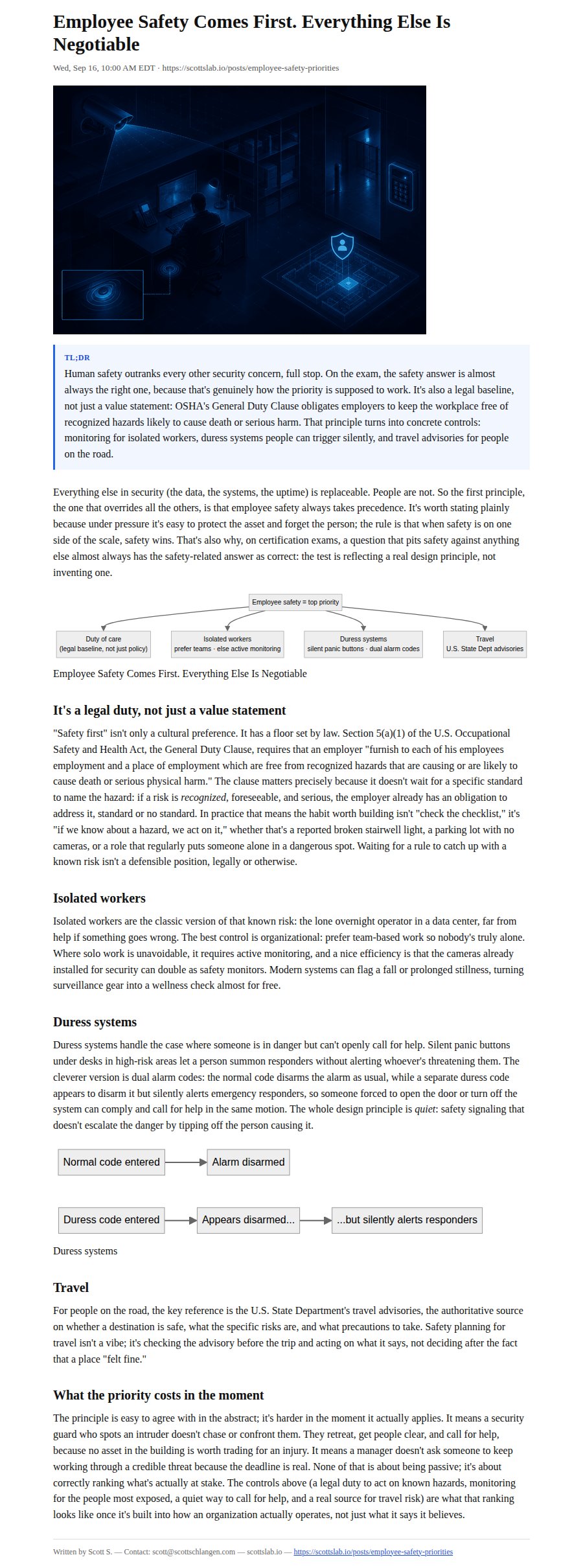
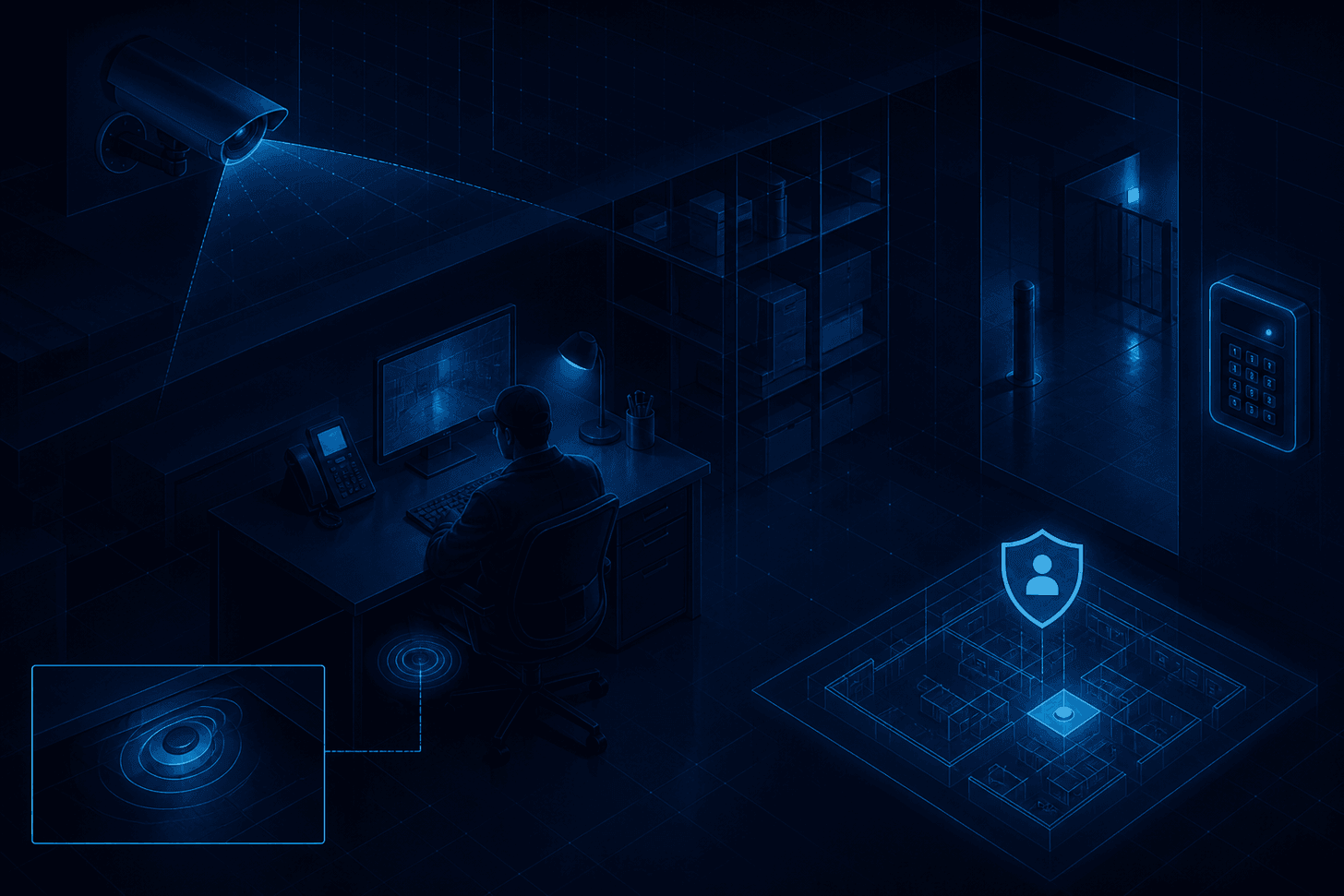
Isolated workers are the classic version of that known risk: the lone overnight operator in a data center, far from help if something goes wrong. The best control is organizational: prefer team-based work so nobody's truly alone. Where solo work is unavoidable, it requires active monitoring, and a nice efficiency is that the cameras already installed for security can double as safety monitors. Modern systems can flag a fall or prolonged stillness, turning surveillance gear into a wellness check almost for free.
Duress systems
Duress systems handle the case where someone is in danger but can't openly call for help. Silent panic buttons under desks in high-risk areas let a person summon responders without alerting whoever's threatening them. The cleverer version is dual alarm codes: the normal code disarms the alarm as usual, while a separate duress code appears to disarm it but silently alerts emergency responders, so someone forced to open the door or turn off the system can comply and call for help in the same motion. The whole design principle is quiet: safety signaling that doesn't escalate the danger by tipping off the person causing it.
Travel
For people on the road, the key reference is the U.S. State Department's travel advisories, the authoritative source on whether a destination is safe, what the specific risks are, and what precautions to take. Safety planning for travel isn't a vibe; it's checking the advisory before the trip and acting on what it says, not deciding after the fact that a place "felt fine."
What the priority costs in the moment
The principle is easy to agree with in the abstract; it's harder in the moment it actually applies. It means a security guard who spots an intruder doesn't chase or confront them. They retreat, get people clear, and call for help, because no asset in the building is worth trading for an injury. It means a manager doesn't ask someone to keep working through a credible threat because the deadline is real. None of that is about being passive; it's about correctly ranking what's actually at stake. The controls above (a legal duty to act on known hazards, monitoring for the people most exposed, a quiet way to call for help, and a real source for travel risk) are what that ranking looks like once it's built into how an organization actually operates, not just what it says it believes.